
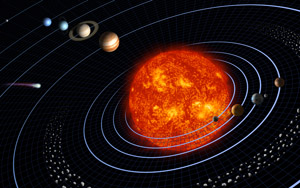
Our Solar System includes the Sun and the planetary system revolving around it. A “planetary system” is a group of non-stellar objects (planets, dwarf planets, moons, asteroids, meteoroids, comets and cosmic dust) that orbit around a star, the sun is classified as a star.
The Solar System includes four terrestrial planets (composed of rock and metal) and four gas giants (gaseous material). The four terrestrial planets are Mercury, Venus, Earth, and Mars, and the four gas giants are Jupiter, Saturn, Uranus, and Neptune. These names are derived from Roman gods and goddesses. So how many planets have we mentioned?
Eight! Just checking if you are still awake.
Scientists believe that the Solar System was formed billions of years ago through the gravitational collapse of a cluster of gas and dust particles in space. The Sun is said to have been formed out of the mass in the center, and the these materials slowly formed the other non-stellar objects; planets, moons, and asteroids. The Solar System is an enigma, with man's quest to learn more, astronomers and scientist continually learn something new about the vastness of space. As technology improves, so we learn more about our Solar System.
It is said that the Sun is halfway in the cycle that began at its birth and ending with its final expansion and collapse as a red giant (the 10 billionth year mark of its life). An event you don't want to be around for.
Not Just Planets
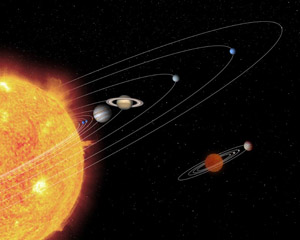 The Solar System includes the planets’ satellites (moons), comets, asteroids, and meteoroids. Located between Mars and Jupiter is a small asteroid belt. Even though there are only eight planets, our Solar System actually contains hundreds of star systems.
Some of the moons in our Solar System are larger than the planet Mercury! Two of the moons of Jupiter have interesting characteristics; Io has active volcanoes, Europa has a thick liquid water ocean layer, though covered by thick crusts of solid ice. Titan, the largest moon of Saturn, has lakes, rivers, and oceans of liquid Methane!
Beyond Neptune’s orbital path lie trans-Neptunian formations made of ice water, ammonia, and methane. Ceres, Pluto, Haumea, Makemake, and Eris rotate using their own gravity like the other planets, however, for this reason, the scientific community has called these “dwarf planets.”
Atmospheres, Rings, Magnetic fields
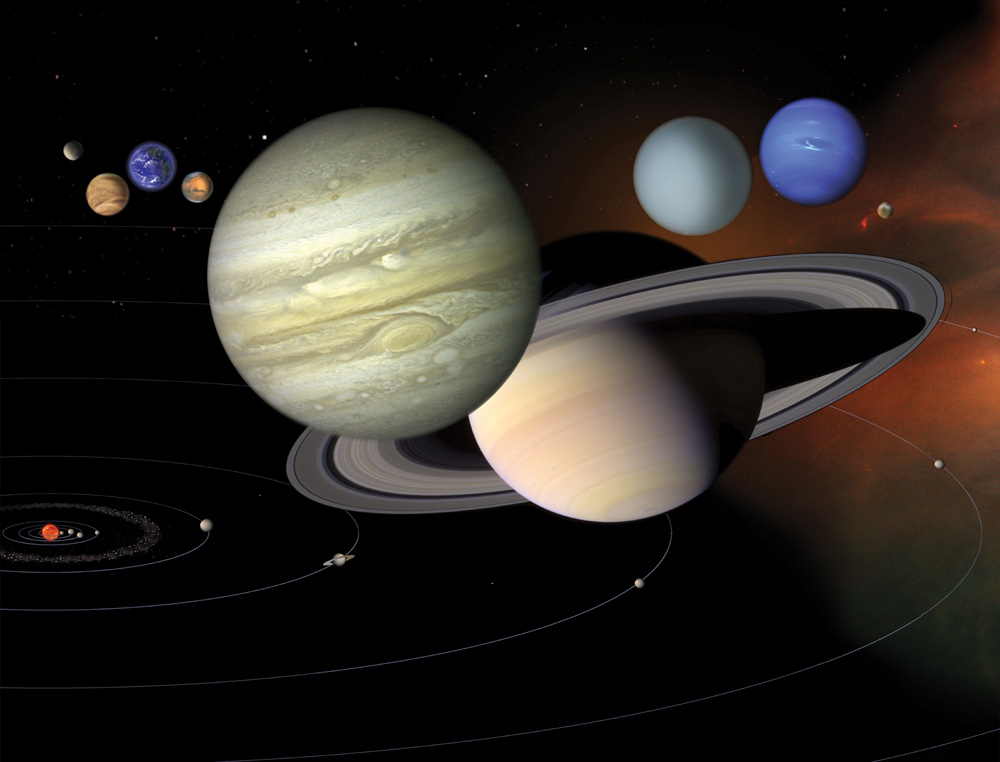 Nearly every planet, and some moons, is shrouded with atmospheric gases. Take Venus for example, it has a thick atmosphere of carbon dioxide and other toxic gases. Earth’s atmosphere consists of mostly nitrogen and oxygen. Mars’ atmosphere is also has a thin layer of carbon dioxide. The gas giants contain hydrogen and helium in their atmospheres.
From the 17th century to the 1970s, astronomers believed that only Saturn had an outer ring. With the advent of modern telescopes, scientists have observed rings on the other planets, Jupiter, Uranus, and Neptune. Although these planets’ rings are not as prominent as Saturn’s. What are seen as planetary rings are actually clusters of various particles that include dust, asteroids & boulders, they range in size from tiny specks to some that are big as your house!
Planets and stars in the Solar System have magnetic fields, the charged particles surround most of these celestial bodies. The sun has a magnetic field of its own called the heliosphere, this emanates throughout the Solar System.
The Sun
 The Sun is the star at the center of the Solar System. It consists of hot lava and a strong magnetic field. The energy it produces can be likened to hydrogen nuclear fusion reactions at its core. The Sun mass is estimated at 99.86% of the in Solar System, the rest belongs to Jupiter. The Sun consists of 70% hydrogen, 28% helium, and 2% of the remaining consists of carbon, oxygen, iron, neon, and other elements.
By classification the Sun is a yellow dwarf. It is about the top 10th percentile in mass among all stars. It has a surface temperature of about 5505°C (9941°F).
The corona of the Sun is constantly expanding, thus producing a solar wind (charged particle stream that is emitted from the Sun's upper atmosphere). The solar wind is responsible for creating the heliosphere, which is a large bubble that expands into the outer area of the Solar System known as the interstellar medium. Phenomena such as geomagnetic storms can disrupt Earth's power grid, Northern Lights, as well as comet plasma tails which are always aligned away from the Sun.
The Sun is often represented in ancient cultures, more often than not, as a deity or god. The ancient Egyptians called it as the god Ra, the Greeks as Helios, and the Romans as Sol.
The Planets
Mercury
 Mercury is the smallest and closest planet to the Sun. Mercury has no moons and has no special features other than impact craters and lobed ridges. Mercury's thin atmosphere consists of particles blasted off by the solar wind from the Sun. It has a large iron core and a thin mantle layer, possibly constant impacts which prevent its layers from developing over time.
Venus
 The second planet is slightly smaller than Earth. It has a dense atmosphere and an iron core. It is the hottest planet with blistering surface temperatures (upwards of 400°C/752°F). Venus’ atmosphere is toxic due to clouds of sulfuric acid. The planet may have had water at one point, but these have evaporated over time due to the extreme heat. Volcanic activity have been observed on Venus’ surfaces, though there have been no signs of lava flow.
Earth
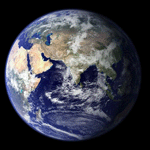 Earth is the largest of the inner planets. It is the only place in the universe where life exists. It has one moon. Earth's core is very active, and it is the only planet with tectonic plates. Earth’s biosphere has long since altered its atmosphere, creating more oxygen as well as an ozone layer to block harmful radiation from space.
Mars
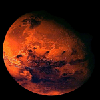 This is the second largest planet and the fourth from the Sun. Mars has a carbon dioxide atmosphere. It has two moons: Deimos and Phobos. These are said to be captured asteroids. Its reddish color is due to the large amounts of iron-oxide on its surface. Its atmosphere is very thin and its surface is riddled with impact craters, like that of the Moon’s.
Jupiter
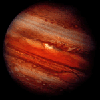 Jupiter the size is massive, consider 318 times the Earth size. It is the largest planet in the Solar System with 2.5 times the mass of all the other planets combined. It is composed of mostly hydrogen and helium. Jupiter has 67 known moons or satellites. Jupiter has a rapid rotation which has caused it to bulge slightly around its equator. The atmosphere of Jupiter creates lots of storms on its surface, the prominent result of which is the Great Red Spot, which is actually a continuous storm which has endured since the 17th century (when it was first observed by telescope).
Saturn
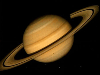 This planet is just beyond Jupiter and is known for its ring, which actually consists of 9 bands of rings. Saturn is 60% the volume of Jupiter and has the lowest density of all the planets. It has 62 satellites, including Titan and Enceladus. Saturn’s core consists of iron, nickel, silicon, and oxygen compounds, all surrounded by a thick layer of metallic hydrogen. The planetary magnetic field on Saturn has contributed to an electric current through the metallic hydrogen layer.
Uranus
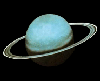 Uranus is unique in that it orbits the sun on its side because of its axial tilt. Uranus has 27 known moons, including Titania, Oberon, Umbriel, Ariel, and Miranda. While Uranus is similar to Jupiter and Saturn in that its atmosphere contains hydrogen and helium, it also contains copious amounts of ice water, ammonia, and methane. Furthermore, it has the coldest atmosphere in the Solar System at -224°C/-435°F. Uranus and Neptune are also known as “ice giants.”
Neptune
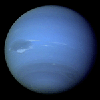 Neptune is smaller than Uranus but is denser. Neptune has 13 known satellites, including Triton. Neptune’s surface gravity is only surpassed by Jupiter, and the two are the only planets with greater surface than Earth’s. Neptune contains ice compounds like those of Saturn’s as well as greater concentrations of volatile elements similar to those found on Jupiter and Saturn.
Pluto
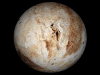 Pluto used to be considered a planet in the sense that Mercury or Jupiter are. However, it is now considered a dwarf planet because it lacks characteristics that define the planets in the Solar System.